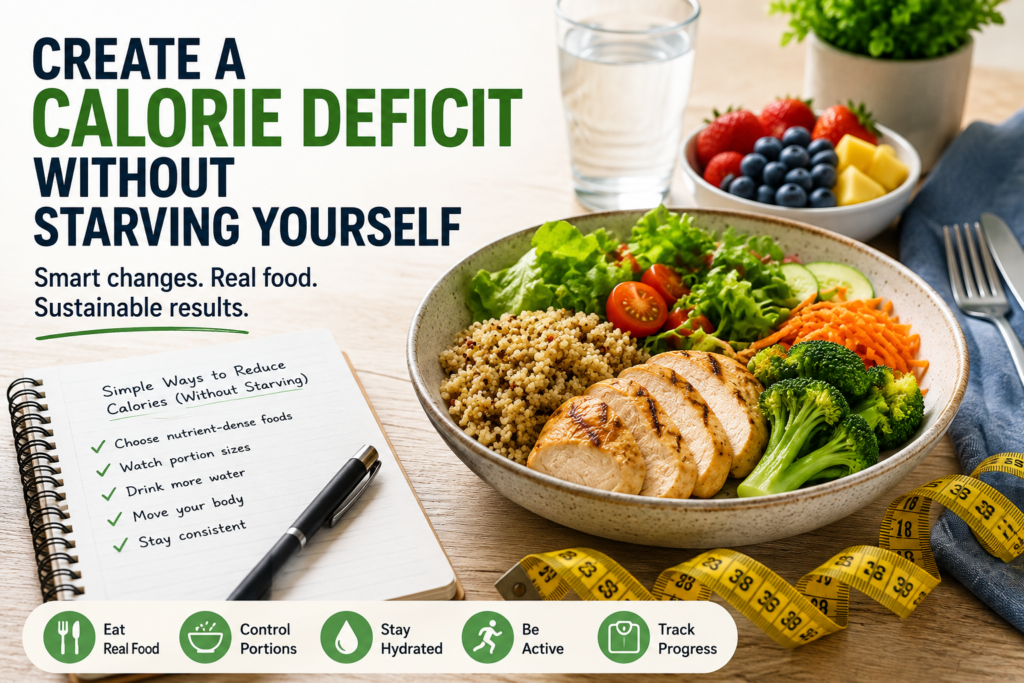
The term “calorie deficit” appears almost everywhere in weight-loss advice.
You may hear that you need to eat dramatically less, skip meals, eliminate carbohydrates, fast for long periods, or live on tiny portions to create one.
But a calorie deficit does not automatically mean extreme restriction.
At its simplest, a calorie deficit occurs when your body uses more energy than you take in from food and beverages over time.
For people for whom weight loss is appropriate, creating a manageable difference between energy intake and energy use can support weight loss. The challenge is finding an approach that provides adequate nutrition and is realistic enough to maintain.
This guide explains the basic idea without turning calorie reduction into a starvation diet.
Important: Weight and calorie needs vary considerably between individuals. This article cannot determine whether you should lose weight or how many calories you personally should consume. If you have a medical condition, take medications that affect weight or appetite, are pregnant or breastfeeding, have a history of disordered eating, or need individualized nutrition advice, consult an appropriately qualified healthcare professional.
What Is a Calorie Deficit?
Your body uses energy continuously.
Energy is needed for basic biological functions as well as movement, exercise, digestion, and everyday activities.
Food and beverages provide energy, commonly measured in calories.
Over time, if you consistently consume more energy than your body uses, the excess can contribute to weight gain.
If you consume less energy than your body uses, this energy imbalance can contribute to weight loss.
That difference is commonly called a calorie deficit.
The basic concept is straightforward.
Putting it into practice in a healthy and sustainable way can be more complicated.
A Calorie Deficit Does Not Mean Eating as Little as Possible
One of the biggest misunderstandings about calorie deficits is that a larger deficit must always be better.
That can lead people toward unnecessarily restrictive diets.
The objective should not be:
“How little food can I survive on?”
A more useful question is:
“What sustainable changes can reduce my energy intake while still supporting an appropriate eating pattern?”
Successful weight-management approaches generally focus on sustainable eating and lifestyle changes rather than simply attempting to minimize food intake.
Extreme restriction can also make a plan difficult to maintain.
You Don’t Need to Be Hungry All Day
Some hunger before meals is a normal part of everyday life.
But constantly feeling intensely hungry is not something you need to treat as proof that your weight-loss plan is working.
The foods you choose, your portion sizes, meal pattern, activity, sleep, individual physiology, and other factors can all affect how you experience hunger.
Instead of deliberately trying to stay hungry, focus on building meals from foods that contribute useful nutrition while fitting your overall energy needs.
A weight-management plan needs to function in real life, not merely produce the lowest possible calorie number.
Start by Understanding What You Currently Eat
Before changing your entire diet, it can be useful to understand your current habits.
For several days, consider paying attention to what you normally eat and drink.
You might notice:
- what you eat at meals,
- what you snack on,
- what beverages you consume,
- approximate portions,
- situations in which you eat when you are not physically hungry, and
- foods or drinks that contribute substantial calories without being particularly satisfying.
This does not require judging yourself.
The purpose is simply to gather information.
You cannot make informed changes to habits you have never noticed.
Look at Beverages
Drinks can be easy to overlook when thinking about calorie intake.
Depending on what you normally drink, beverages can contribute meaningful amounts of energy.
Examples can include some:
- soft drinks,
- sweetened coffees,
- sweetened teas,
- energy drinks,
- milk-based drinks,
- juices, and
- other caloric beverages.
That does not mean every calorie-containing beverage must disappear from your diet.
Instead, look at what you consume regularly.
If a beverage contributes substantial calories but is not especially important to you, changing its amount or frequency may be one possible way to reduce overall calorie intake.
Water is a straightforward beverage option for hydration.
Pay Attention to Portions
You can eat nutritious foods and still consume more energy than your body requires.
That is one reason portion awareness can be useful.
You do not necessarily need to weigh every ingredient indefinitely.
Start by observing how much you normally serve yourself.
Consider whether you:
- regularly eat very large restaurant portions,
- automatically take second servings,
- snack directly from large packages,
- continue eating after feeling comfortably satisfied, or
- eat while distracted and barely notice how much you consume.
Small changes to repeated behaviors can accumulate over time.
Build Meals Around Nutrient-Dense Foods
Reducing calories should not mean removing nutrition from your diet.
A more useful strategy is to build an eating pattern containing a variety of nutrient-dense foods appropriate for your circumstances.
Depending on your preferences and nutritional needs, that can include foods such as:
- vegetables,
- fruits,
- whole grains,
- beans, peas and lentils,
- suitable protein foods,
- dairy or appropriate alternatives, and
- foods providing appropriate sources of dietary fat.
Different foods provide different combinations of nutrients.
Your goal should not simply be to make meals contain the fewest calories possible.
Think about the nutritional quality of your overall diet as well.
Include Foods That Make Meals Satisfying
A meal consisting of a tiny amount of food may technically contain fewer calories, but that does not automatically make it a practical meal.
When planning meals, consider whether they contain an appropriate combination of foods that you enjoy and find satisfying.
For example, depending on your dietary needs and preferences, meals might combine vegetables or fruit with a suitable protein source, grains or other carbohydrate-containing foods, and other appropriate foods.
There is no single meal structure that everyone must follow.
The objective is to develop meals you can realistically continue eating while working toward your goals.
Don’t Automatically Eliminate Carbohydrates
Creating a calorie deficit does not require eliminating carbohydrates.
Carbohydrate-containing foods include many different foods, including fruits, vegetables, beans, grains, milk, breads, cereals, and numerous other products.
These foods do not all have the same nutritional characteristics.
Rather than banning an entire macronutrient, consider your overall food choices, portions, nutritional needs, and total eating pattern.
A diet does not become effective simply because it has a long list of forbidden foods.
Dietary Fat Is Not Automatically the Enemy Either
Dietary fat provides more calories per gram than carbohydrate or protein, so portions of high-fat foods can influence total calorie intake.
But that does not mean a healthy eating pattern must eliminate fat.
Foods such as nuts, seeds, avocados, certain fish, and oils can contribute dietary fats as well as other nutrients.
Again, context and portions matter.
Weight management is not helped by turning individual nutrients into villains.
You Don’t Have to Give Up Every Food You Enjoy
Trying to create a “perfect” diet can make weight management unnecessarily restrictive.
Foods you enjoy do not automatically need to disappear forever.
NIDDK notes that small amounts of favorite higher-calorie foods can sometimes fit within a weight-loss eating plan when overall calorie intake is considered.
This can be a more sustainable mindset than labeling foods as permanently forbidden.
Think about frequency and portions rather than assuming that one particular food will ruin all your progress.
Physical Activity Can Contribute Too
A calorie deficit is not created only by changing food intake.
Physical activity increases energy expenditure and provides health benefits beyond its effect on body weight.
That does not mean you should try to “burn off” everything you eat.
Exercise should not become punishment for food.
Instead, regular physical activity can complement an appropriate eating pattern.
Current U.S. guidance generally recommends adults work toward at least 150 minutes of moderate-intensity aerobic activity each week together with muscle-strengthening activity on at least two days per week. People who are currently inactive can begin with smaller amounts and gradually build activity.
If you are new to exercise, read our guide to starting exercise when you’re out of shape.
You can also read our beginner strength training at home guide.
Don’t Use Exercise as Permission to Overeat
There is another side to the exercise equation.
It can be easy to overestimate how much energy a workout uses and then assume that exercise automatically compensates for any amount of food.
Rather than trying to calculate every workout against every meal, think about food and physical activity as parts of a broader lifestyle.
Exercise because physical activity supports health and fitness.
Manage your eating pattern according to your nutritional and weight-management needs.
You do not need to turn every meal and workout into a mathematical transaction.
Small Changes Can Add Up
A calorie deficit does not necessarily require one enormous dietary change.
Sometimes several manageable changes can influence overall intake.
For example, depending on your existing habits, you might:
- reduce the frequency of a high-calorie beverage,
- adjust an oversized portion,
- choose a different snack sometimes,
- add vegetables or fruit to meals,
- reduce mindless eating while watching television, or
- become more physically active.
These are examples, not a universal prescription.
The most useful changes depend on what you currently do.
Avoid the “Perfect Monday” Cycle
A common pattern in dieting looks like this:
Overeat → feel guilty → start an extreme diet Monday → become overly restricted → abandon diet → repeat
That cycle can make weight management unnecessarily difficult.
Instead of repeatedly attempting a perfect diet, aim for habits that can survive normal life.
You will have restaurant meals.
You may attend celebrations.
You will occasionally eat differently than planned.
One meal does not determine the success of your overall eating pattern.
Return to your normal habits rather than treating an imperfect day as a reason to abandon them.
Your Calorie Needs Are Individual
There is no single calorie target that is appropriate for every adult.
Energy needs can vary according to factors including:
- age,
- sex,
- body size,
- physical activity,
- metabolism,
- health circumstances, and
- other individual factors.
This is why copying a calorie target from an influencer, friend, or random online diet can be inappropriate.
NIDDK provides a Body Weight Planner designed for adults that can help estimate how changes in calorie intake and physical activity may relate to weight goals, but it is not intended for pregnant or breastfeeding women or people under 18.
Individualized professional guidance may be appropriate when you need a specific calorie prescription.
Don’t Chase the Fastest Possible Weight Loss
Fast results can be emotionally appealing.
But the fastest approach is not necessarily the easiest to maintain.
Successful weight-management programs emphasize realistic goals, an appropriate reduced-calorie eating plan, physical activity, behavioral support, and strategies for maintaining progress over time.
Think beyond what happens during the first week.
Ask yourself whether your current approach could realistically become part of your life for months rather than days.
Weight Loss Is Not Perfectly Predictable
Human bodies are more complicated than a simple calculator.
Body weight can fluctuate for many reasons, and energy requirements can change as body weight changes.
NIDDK notes that metabolism can slow during weight loss and that the body may require fewer calories at a lower weight.
This is one reason simplistic formulas should not be treated as guarantees.
A calculated calorie deficit is an estimate, not a promise that body weight will change by an exact amount on an exact schedule.
Track Trends Rather Than One Day
Your eating and activity will naturally vary from day to day.
One unusually large meal does not automatically mean you have failed.
Similarly, one very low-calorie day does not create a successful long-term strategy.
Look at patterns.
You might track:
- food and beverage habits,
- physical activity,
- portions,
- consistency with planned behaviors, and
- weight trends when appropriate.
NIDDK includes self-monitoring among strategies used in structured weight-management approaches.
The purpose of tracking is to learn from your behavior, not to punish yourself.
Sleep and Other Factors Matter Too
Weight is not determined exclusively by food and exercise.
Factors that may affect weight include lifestyle habits, sleep, medications, health conditions, family history, genes, and a person’s environment.
That does not make energy balance irrelevant.
It means weight management occurs inside a much larger biological and behavioral system.
Be cautious with anyone who claims that every person’s weight can be explained by one simple habit.
Be Careful With “Fat-Burning” Supplements
A calorie deficit does not require a special supplement, detox drink, tea, powder, or “fat burner.”
Marketing claims can make products sound as though they replace ordinary eating and activity habits.
Do not assume that a product is safe or effective simply because it is described as natural.
Supplements may also interact with medicines or be inappropriate for certain people.
If you are considering a supplement for weight management, particularly if you have a health condition or take medication, discuss it with an appropriately qualified healthcare professional.
An affiliate advertisement should never replace individualized medical advice.
Connect This With Your Overall Weight-Loss Plan
A calorie deficit is one part of understanding weight management.
It should not become your entire strategy.
Your broader approach should also consider nutritional quality, physical activity, sleep, habits, preferences, sustainability, and your individual health circumstances.
For a broader introduction, read our guide on how to start losing weight without extreme dieting.
For meal-planning basics, see how to build a balanced meal.
These articles together give readers a much better foundation than treating calorie counting as the entire weight-management process.
When Should You Seek Professional Guidance?
General online information cannot determine the correct calorie intake or weight goal for every person.
Consider individualized guidance if you:
- are unsure whether weight loss is appropriate for you,
- have a medical condition,
- take medicines that affect appetite or body weight,
- are pregnant or breastfeeding,
- are under 18,
- have a history of an eating disorder or concerns about restrictive eating,
- experience concerning symptoms,
- need an individualized nutrition plan, or
- have difficulty managing your weight despite sustained lifestyle changes.
A qualified healthcare professional or appropriately credentialed nutrition professional can consider information that a general article cannot.
A Simpler Way to Think About a Calorie Deficit
Instead of:
Eat as little as possible → stay hungry → lose weight quickly
think:
Understand current habits → Make manageable changes → Prioritize nutritious foods → Stay appropriately active → Track progress → Adjust when needed
A sustainable calorie deficit should fit within an overall approach you can realistically maintain.
The Bottom Line
A calorie deficit means taking in less energy than your body uses over time.
But creating one does not require starving yourself, eliminating entire food groups, or following an extreme diet.
If weight loss is appropriate for you, focus on manageable changes to your overall food and beverage intake while maintaining a nutritious eating pattern and staying physically active.
Pay attention to portions, beverages, food choices, activity, and repeated habits rather than looking for one dramatic solution.
Your calorie needs and appropriate weight goals are individual.
When you need specific guidance, work with an appropriately qualified healthcare professional rather than copying a generic calorie target from the internet.
Sources
National Institute of Diabetes and Digestive and Kidney Diseases (NIDDK). Eating & Physical Activity to Lose or Maintain Weight.
National Institute of Diabetes and Digestive and Kidney Diseases (NIDDK). Choosing a Safe & Successful Weight-loss Program.
National Institute of Diabetes and Digestive and Kidney Diseases (NIDDK). Factors Affecting Weight & Health.
Consider your individual circumstances and consult an appropriate qualified healthcare professional when needed.