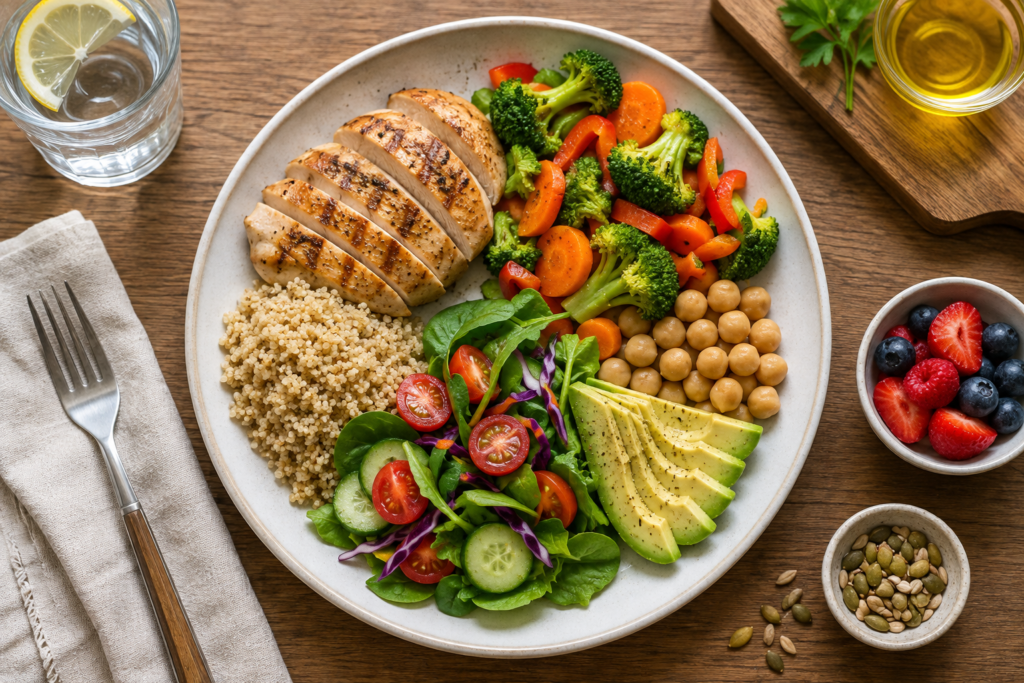
Healthy eating can sound much more complicated than it needs to be.
One source tells you to avoid carbohydrates. Another focuses almost entirely on protein. Social media can make everyday meals look as though they require expensive ingredients, complicated recipes, or precise tracking of every calorie and nutrient.
For most people, however, building a more balanced eating pattern can start with something much simpler: looking at the overall combination of foods you regularly eat.
This guide explains a practical way to think about balanced meals without expecting every plate to be nutritionally perfect.
Important: Nutrition needs vary from person to person. This article provides general educational information and is not an individualized meal plan. People with medical conditions, food allergies, special dietary requirements, pregnancy or breastfeeding, or other nutrition concerns should seek appropriate individualized guidance from a qualified healthcare professional.
Think About Your Overall Eating Pattern
Healthy eating is not determined by one meal.
An occasional meal that is less balanced does not automatically make someone’s overall diet unhealthy, just as eating one salad does not automatically create a healthy eating pattern.
A more useful approach is to consider what you tend to eat and drink repeatedly over days and weeks.
Current U.S. dietary guidance emphasizes prioritizing whole, nutrient-dense foods while considering the foods and beverages that make up your overall diet.
This gives you more flexibility.
Instead of asking:
“Is this one food healthy or unhealthy?”
consider asking:
“How does this food fit into what I normally eat?”
That perspective can make healthy eating more practical and less rigid.
Focus on a Variety of Nutrient-Dense Foods
You do not need to memorize the nutrient content of every food before putting together a meal.
Current U.S. dietary guidance emphasizes eating a variety of nutrient-dense foods as part of an overall healthy eating pattern.
Depending on your preferences and individual needs, meals can include foods such as:
- vegetables,
- fruits,
- protein foods,
- whole grains,
- dairy or appropriate alternatives, and
- foods that provide healthy fats.
The exact combination does not need to look identical at every meal.
A more practical goal is to include a useful variety of foods across your overall eating pattern while considering your nutritional needs, culture, preferences, budget, and food availability.
Give Fruits and Vegetables Plenty of Room
Fruits and vegetables can play an important role in a nutrient-dense eating pattern, and including a variety of them regularly can help provide essential nutrients.
A practical approach is to look for opportunities to include fruits or vegetables in meals and snacks that already fit your normal eating habits.
Depending on the meal, this could include foods such as:
- leafy greens,
- tomatoes,
- carrots,
- broccoli,
- peppers,
- beans or peas where appropriate,
- berries,
- apples,
- oranges,
- melon, or
- other fruits and vegetables you enjoy.
Fresh produce is not the only option.
Depending on the product and how it is prepared, frozen, canned, dried, and other forms can also contribute to an eating pattern.
The important point is variety and finding options that work for your preferences, budget, and circumstances.
Include a Source of Protein
Protein foods can be another part of a balanced meal.
Depending on your preferences and dietary pattern, examples can include:
- fish and seafood,
- poultry,
- lean meats,
- eggs,
- beans,
- peas,
- lentils,
- nuts,
- seeds, and
- soy foods.
You do not have to rely on the same protein source every day.
Using different foods can add variety to your meals and provide different combinations of nutrients.
Your individual protein needs depend on several factors, so a general online article cannot determine the exact amount that is appropriate for you.
Don’t Automatically Fear Carbohydrates
Carbohydrates are sometimes portrayed online as something everyone needs to eliminate.
That oversimplifies nutrition.
Foods containing carbohydrates include many very different foods, including fruits, vegetables, beans, milk, grains, breads, cereals, and numerous other foods.
Rather than treating all carbohydrates as identical, consider the types of foods supplying them and how those foods fit into your overall eating pattern.
Grain foods, for example, can be part of a balanced diet.
Current U.S. dietary guidance encourages choosing whole grains as part of a nutrient-dense eating pattern while limiting heavily refined carbohydrate foods.
Examples may include oatmeal, brown rice, whole-grain breads, or other whole-grain foods.
You do not need to eliminate an entire macronutrient simply because a diet trend labels it negatively.
Remember That Dietary Fat Has a Place Too
A balanced diet does not require eliminating all fat.
Fat is naturally present in many foods, and different foods contain different types and amounts of fat.
Foods such as nuts, seeds, certain fish, avocados, and vegetable oils are examples of foods that can contribute fats to an eating pattern.
At the same time, overall food choices still matter.
The objective is not to make one nutrient the hero or villain of your diet.
Think about the complete eating pattern rather than building your diet around fear of a single nutrient.
Consider Dairy or Suitable Alternatives
Dairy foods can also be part of a nutrient-dense eating pattern.
Depending on your preferences and needs, dairy foods can include options such as milk, yogurt, and cheese.
Some people do not consume dairy because of dietary preferences, intolerance, allergy, or other reasons.
In those situations, appropriate fortified alternatives may sometimes be used depending on individual nutritional needs.
Not every product marketed as a dairy alternative has the same nutritional profile, so labels can be useful when comparing options.
People who need to avoid particular foods for medical reasons should seek individualized advice when appropriate.
Your Plate Doesn’t Have to Look Perfect
Nutrition graphics can accidentally create the impression that every meal needs to look like a perfectly divided plate.
Real meals are often more complicated.
Consider a soup, stew, sandwich, burrito, curry, casserole, or mixed bowl.
Several food groups may already be combined into one dish.
Instead of worrying about physically separating everything on the plate, consider the ingredients that make up the meal.
A mixed meal might contain vegetables, a grain, and a protein food all together.
The principle matters more than making every meal visually resemble a diagram.
Build Meals From Foods You Actually Enjoy
A theoretically nutritious meal is not particularly useful if you dislike it so much that you never want to eat it again.
Healthy eating can accommodate personal and cultural preferences.
You do not have to replace familiar foods with trendy ingredients simply because they appear frequently in health content.
Instead, think about how meals you already enjoy could include a useful variety of food groups.
For example, depending on your normal eating style, you might add a vegetable side, include a suitable protein food, choose a whole-grain option sometimes, or add fruit to a meal.
Small adjustments can be easier to maintain than completely replacing your normal diet.
Convenience Foods Can Still Fit
Not everyone has the time, equipment, budget, or interest to cook every meal from scratch.
Healthy eating advice should recognize that reality.
Convenient options can still contribute useful foods to meals.
Examples might include:
- frozen vegetables,
- canned beans,
- canned or packaged fish where appropriate,
- pre-cut vegetables,
- plain frozen fruit,
- whole-grain bread,
- yogurt, or
- other simple foods requiring little preparation.
When choosing packaged foods, nutrition labels can help you compare products.
The goal is not to achieve dietary perfection.
It is to make practical choices within your actual circumstances.
Pay Attention to Drinks
What you drink is also part of your overall eating pattern.
Water is a straightforward beverage option.
Other beverages vary considerably in calories, added sugars, and nutritional content.
You do not necessarily need to classify every drink as forbidden or acceptable.
Instead, pay attention to what you regularly drink and how those beverages contribute to your overall intake.
If most of your attention goes toward food while drinks go unnoticed, you may be overlooking an important part of your normal eating habits.
Portion Size Still Matters
Eating nutritious foods does not mean portion size becomes completely irrelevant.
At the same time, balanced eating does not require becoming anxious about precisely measuring everything you eat.
A practical approach is to develop awareness.
You might notice:
- how much you usually serve yourself,
- whether you are still hungry after eating,
- whether you routinely eat while distracted,
- how often you take additional servings, and
- whether your portions change significantly in different situations.
The goal is awareness rather than obsession.
Individual energy and nutrition needs vary, so this article cannot specify the correct portion size for every reader.
Don’t Let One Meal Define Your Diet
Imagine that you eat a balanced breakfast and lunch but later have pizza with friends.
That does not erase everything else you ate.
Similarly, eating vegetables at dinner cannot compensate for an otherwise consistently poor eating pattern.
Nutrition makes more sense when viewed over time.
Instead of trying to make every meal perfect, aim for an overall pattern you can realistically maintain.
This approach also leaves room for enjoyment, social meals, traditions, celebrations, and normal variations in everyday life.
Be Skeptical of Foods Marketed as Miracles
Healthy eating does not depend on discovering one special ingredient.
Be cautious with claims that a particular food, drink, powder, supplement, or “superfood” can transform your health by itself.
Nutrition works within a much larger context.
Your overall dietary pattern, physical activity, sleep, health circumstances, genetics, environment, and other factors can all matter.
A single product should not be presented as a substitute for a balanced eating pattern or appropriate medical care.
Supplements Don’t Automatically Make a Diet Better
A supplement is not automatically beneficial simply because it contains vitamins, minerals, herbs, or ingredients described as “natural.”
People have different nutritional needs, and supplements can have different effects depending on the product and individual circumstances.
Some products may also interact with medications or be inappropriate for certain people.
If you are considering a dietary supplement because you believe you have a deficiency or health problem, an appropriately qualified healthcare professional can help determine whether individualized assessment is needed.
Do not use an affiliate advertisement or online testimonial as a substitute for professional guidance.
Start With One Meal
If improving your entire diet feels overwhelming, you do not need to redesign every meal immediately.
Choose one meal you eat regularly.
Look at what it normally contains.
Then ask simple questions:
Could I include a fruit or vegetable?
Is there an appropriate protein source?
Could I sometimes choose a whole-grain option?
What am I normally drinking with this meal?
You might find one simple improvement without changing everything else.
Once that becomes familiar, you can look at another meal.
A Simple Way to Think About a Balanced Meal
Instead of trying to calculate every nutrient, start with a flexible framework:
Include plant foods → Add an appropriate protein food → Include suitable grains or other foods → Consider dairy or an appropriate alternative → Choose a beverage
This is not an official government formula or a required plate arrangement; it is simply a flexible way to think about variety when planning an everyday meal.
Not every meal will follow this exact sequence.
It is simply a practical way to think about variety.
Your cultural preferences, dietary needs, budget, food availability, and personal circumstances should influence the foods you choose.
When Individual Nutrition Advice Matters
General nutrition information cannot account for everyone’s circumstances.
Individualized professional advice may be particularly useful if you:
- have a medical condition affected by diet,
- have food allergies or intolerances,
- have significant digestive concerns,
- are pregnant or breastfeeding,
- have concerns about your relationship with food,
- have been advised to follow a medically specific diet,
- take medications that affect nutritional needs, or
- are concerned about a possible nutrient deficiency.
An online article cannot replace an individualized assessment.
The Bottom Line
Building a balanced meal does not require following a perfect diet.
Think about your overall eating pattern rather than judging yourself based on individual foods or meals.
Include a variety of fruits and vegetables, protein foods, grains and other appropriate foods while considering your individual preferences and circumstances.
Use general nutrition frameworks as flexible tools rather than rigid rules, and focus on the quality and variety of your overall eating pattern.
Most importantly, choose an approach you can realistically maintain.
Healthy eating is not about creating a perfect plate once.
It is about developing an overall pattern of food choices that works sustainably in everyday life.
Sources
U.S. Department of Health and Human Services and U.S. Department of Agriculture. Dietary Guidelines for Americans, 2025–2030.
U.S. Department of Health and Human Services. Current Dietary Guidelines.
Consider your individual circumstances and consult an appropriate qualified healthcare professional when needed.