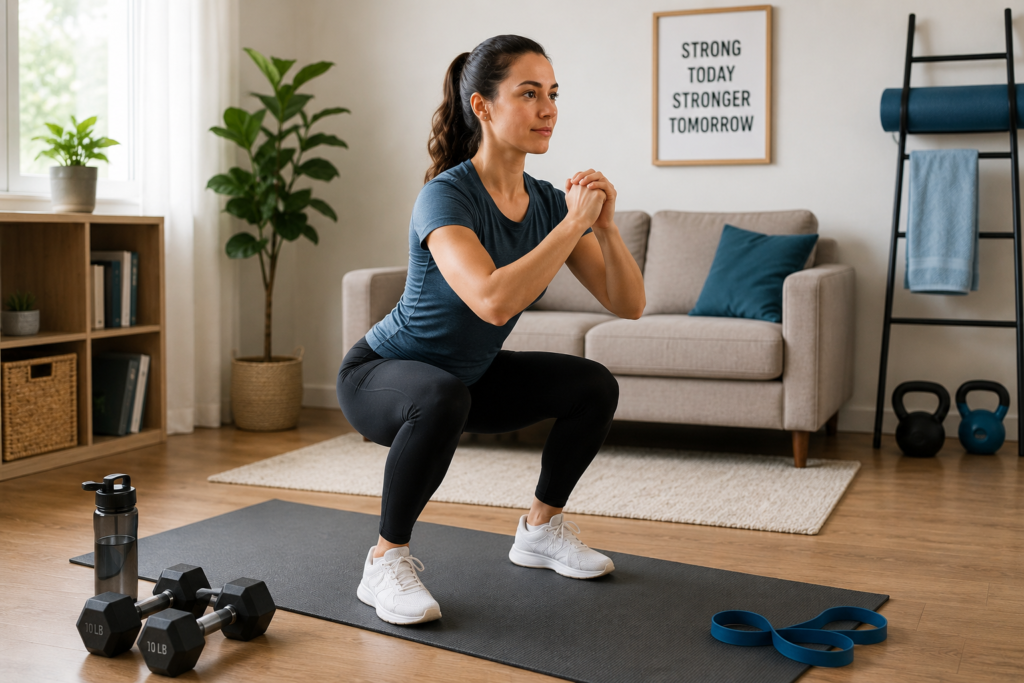
Starting strength training can feel intimidating when you are new to exercise.
You may picture a crowded gym, complicated machines, heavy barbells, or workout programs filled with exercises you have never tried before.
But strength training does not have to begin that way.
Many beginners can start learning basic resistance exercises at home using body weight, resistance bands, weights, or other appropriate forms of resistance.
The goal at the beginning is not to lift as much weight as possible. It is to learn manageable movements, develop a consistent routine, and gradually progress as your ability improves.
Important: Exercise needs and abilities vary from person to person. If you have a medical condition, injury, concerning symptoms, significant limitations, or questions about whether strength training is appropriate for you, seek individualized advice from an appropriately qualified healthcare professional.
What Is Strength Training?
Strength training is physical activity that makes your muscles work harder than they normally do.
The U.S. Physical Activity Guidelines describe muscle-strengthening activities as activities that overload the muscles.
Examples can include:
- lifting weights,
- exercising with resistance bands,
- bodyweight exercises,
- carrying heavy loads, and
- certain other activities that require the muscles to work against resistance.
You do not necessarily need a gym membership or an expensive collection of equipment to begin.
The appropriate type of resistance depends on the exercise, your abilities, your experience, and what equipment you can safely access.
Why Include Strength Training?
Aerobic activities such as walking and cycling are valuable, but they are not the only components of an active lifestyle.
Muscle-strengthening activities provide benefits that complement aerobic activity.
According to U.S. physical-activity guidance, muscle-strengthening activity can help improve muscular fitness and bone strength.
For beginners, another useful benefit is practical: becoming stronger may make many everyday physical tasks easier to perform.
That does not mean you need to train like a competitive athlete.
Strength training can simply be one part of a balanced approach to physical activity.
You Can Start at Home
One advantage of home strength training is simplicity.
Depending on the exercises you choose, you may be able to begin with very little equipment.
Bodyweight movements use your own body as resistance.
Resistance bands provide another portable option.
Weights can also be used when appropriate.
The important question is not whether one method looks more impressive than another.
Ask instead:
“Can I perform this exercise appropriately and progress it gradually?”
A simple routine that you can consistently perform is generally more practical than an elaborate program you quickly abandon.
Learn the Movement Before Adding More Resistance
Beginners sometimes focus immediately on how much weight they can lift.
A better early priority is learning how to perform an exercise with appropriate control.
Before substantially increasing resistance, become familiar with the movement.
Depending on the exercise, that may mean:
- moving through a comfortable range of motion,
- maintaining control of the resistance,
- avoiding unnecessary rushing,
- learning how to position your body, and
- stopping when you cannot maintain appropriate technique.
If you are uncertain how to perform an exercise, guidance from an appropriately qualified fitness professional can be useful.
Watching random social-media clips is not always a substitute for reliable instruction.
Start With Basic Movement Patterns
A beginner routine does not need dozens of different exercises.
Depending on your abilities and circumstances, strength training often includes movements that involve major areas of the body.
Examples of general movement categories might include:
- a squat or sit-to-stand type movement,
- a pushing movement,
- a pulling movement,
- a hip-focused movement,
- exercises involving the trunk, and
- appropriate movements for the arms or shoulders.
These are broad categories rather than a required workout.
Not every exercise is appropriate for every person.
Exercise selection should reflect your mobility, experience, available equipment, environment, and any individual limitations.
Bodyweight Exercises Can Count
Strength training does not automatically require dumbbells.
The Physical Activity Guidelines specifically recognize calisthenic exercises that use body weight for resistance as muscle-strengthening activities.
That can make home training more accessible.
Depending on your ability, bodyweight exercise variations may include movements such as appropriately modified squats, wall or elevated push-up variations, and other resistance exercises.
An exercise does not have to be extremely difficult to be useful.
For a beginner, an easier variation that can be performed with control may be more appropriate than attempting an advanced version simply because it looks more challenging.
Resistance Bands Are Another Option
Resistance bands can provide external resistance without requiring a large amount of equipment.
They are available in different resistance levels and can be used for numerous movements.
However, using a band does not automatically make an exercise safe or appropriate.
Before using one, inspect it for damage and make sure it is appropriately secured for the exercise you are performing.
Choose resistance that allows you to maintain control rather than selecting the strongest band simply because it feels more challenging.
What About Dumbbells and Other Weights?
Weights can also be useful for strength training.
The amount of weight appropriate for one person may be completely inappropriate for another.
Rather than choosing a weight based on what somebody else uses, choose resistance based on your own ability to perform the movement appropriately.
As your strength and experience improve, resistance can be adjusted gradually.
You do not need to begin with heavy weights to qualify as strength training.
How Often Should Beginners Strength Train?
Current U.S. physical-activity guidance recommends that adults perform muscle-strengthening activities involving the major muscle groups on at least 2 days each week.
This is a long-term physical-activity guideline, not a requirement that every beginner immediately complete an advanced two-day training program.
If you have been inactive, the guidance also encourages starting with manageable amounts of activity and building gradually.
Your appropriate schedule depends on your current activity level, exercises, recovery, health circumstances, and other factors.
More training is not automatically better.
A Beginner Routine Does Not Need to Be Long
People sometimes assume a workout only counts if it lasts an hour.
Strength training does not need to become an endurance contest.
A beginner may benefit from focusing on a manageable number of exercises rather than filling a workout with unnecessary movements.
For example, someone might choose exercises addressing several major muscle groups and learn those movements before making the routine more complicated.
The exact workout should vary according to individual ability.
Consistency and appropriate progression matter more than making the first workout impressive.
What Are Repetitions and Sets?
Strength-training terminology can initially sound more complicated than it is.
A repetition, often shortened to “rep,” means performing an exercise movement once.
A set is a group of repetitions performed together.
For example, performing a movement 10 times and then resting would generally be described as one set of 10 repetitions.
The Physical Activity Guidelines note that when resistance training is used to improve strength, one set of 8–12 repetitions for an exercise can be effective, although additional sets may sometimes provide greater benefit.
That does not mean every person must use exactly the same repetition range for every exercise.
Your program should reflect your abilities, goals, experience, and appropriate professional guidance where needed.
Don’t Rush Your Repetitions
Moving faster does not automatically make an exercise better.
For beginners, controlled movement can make it easier to concentrate on what you are doing.
Avoid turning every set into a race.
Use resistance you can control and pay attention to how you perform the movement.
If your technique deteriorates significantly as you become tired, that is a reason to reconsider the resistance, exercise variation, or number of repetitions rather than simply forcing additional repetitions.
Progress Gradually
Your body can adapt to resistance training over time.
As an exercise becomes easier, progression may eventually be appropriate.
Progression does not have to mean immediately adding a large amount of weight.
Depending on the exercise and your circumstances, progression might involve adjusting:
- resistance,
- repetitions,
- sets,
- exercise variation,
- range of motion where appropriate, or
- training frequency.
Change does not need to happen all at once.
Gradual adjustments make it easier to evaluate how you respond.
Don’t Copy Someone Else’s Workout Blindly
Online fitness content makes it easy to find thousands of workout routines.
That does not mean every routine is suitable for every beginner.
Someone you watch online may have years of training experience, different mobility, different equipment, different goals, and a completely different health history.
Use workout ideas cautiously.
An appropriate beginner program should reflect the person actually performing it.
You do not need to copy an advanced workout to make progress.
Muscle Fatigue and Pain Are Not the Same Thing
Strength exercise can feel challenging.
However, you should not assume that every uncomfortable sensation is something you need to push through.
Muscular effort or fatigue during exercise is different from concerning pain or symptoms.
Do not use slogans such as “no pain, no gain” as medical guidance.
If you experience concerning symptoms, significant pain, or an injury, stop and seek appropriate professional advice when needed.
A workout does not become more effective simply because it hurts.
Recovery Is Part of Training
Exercise provides a training stimulus, but your routine also needs to allow for recovery.
You do not need to train the same muscles intensely every day simply because you want faster results.
How much recovery you need can depend on the type and difficulty of training, your experience, sleep, nutrition, age, health circumstances, and other factors.
Beginners should resist the temptation to dramatically increase training volume simply because the first few workouts feel exciting.
A routine needs to be sustainable beyond the first week.
Combine Strength Training With Other Activity
Strength training is only one component of physical activity.
U.S. guidance recommends that adults work toward both aerobic and muscle-strengthening activity.
For adults, the broader recommendation includes 150–300 minutes of moderate-intensity aerobic activity per week, or an equivalent amount of vigorous activity, together with muscle-strengthening activity on at least two days each week.
If you are currently inactive, you do not have to suddenly achieve the full target.
Start with manageable amounts and build over time.
For more help with that first step, read our guide to starting exercise when you’re out of shape.
Equipment Is Optional, but Safety Isn’t
Home workouts can be convenient, but your environment still matters.
Before exercising, make sure you have adequate space and that the surface and equipment are appropriate for the activity.
If using weights, bands, benches, chairs, or other objects, make sure they are suitable and stable for their intended use.
Avoid improvising with objects that could break, slip, or create unnecessary risk.
Convenience should not replace basic safety.
Track Progress Without Obsessing Over Numbers
Progress in strength training can appear in several ways.
You might notice that:
- an exercise feels more controlled,
- a previously difficult movement becomes easier,
- you can perform more appropriate repetitions,
- you can gradually use more resistance,
- you are more consistent with your workouts, or
- everyday physical tasks feel easier.
Not every workout needs to produce a personal record.
Progress can be gradual.
Tracking a few basic details about your workouts can help you recognize improvement over time.
A Simple Beginner Mindset
Instead of thinking:
“I need the perfect workout program.”
try:
Learn → Practice → Repeat → Recover → Gradually Progress
Your early workouts are an opportunity to become familiar with resistance training.
You can make the program more sophisticated later if your needs and goals require it.
Starting simple is not a disadvantage.
For many beginners, simplicity makes consistency easier.
When Should You Get Professional Guidance?
General exercise information cannot account for every individual situation.
Consider individualized guidance if you:
- have a medical condition that may affect exercise,
- have an existing or recent injury,
- experience concerning symptoms during activity,
- have significant mobility or balance limitations,
- are unsure how to perform exercises appropriately, or
- need a program designed around specific health or performance goals.
An appropriately qualified healthcare or fitness professional can evaluate information that a general online article cannot.
The Bottom Line
Beginning strength training at home does not require an elaborate gym or an advanced workout program.
Start with manageable resistance, learn basic movements, focus on controlled exercise technique, and gradually progress as your ability improves.
Bodyweight exercises, resistance bands, and weights can all be useful forms of resistance depending on the person and exercise.
Current U.S. guidance recommends muscle-strengthening activity for the major muscle groups on at least two days each week, while also encouraging inactive adults to start small and build their activity over time.
The goal of your first strength workout is not to prove how strong you are.
It is to begin developing a routine that you can safely and realistically continue.
Sources
U.S. Department of Health and Human Services, Office of Disease Prevention and Health Promotion. Physical Activity Guidelines for Americans, 2nd edition.
U.S. Department of Health and Human Services, Office of Disease Prevention and Health Promotion. Move Your Way®.
Consider your individual circumstances and consult an appropriate qualified healthcare professional when needed.