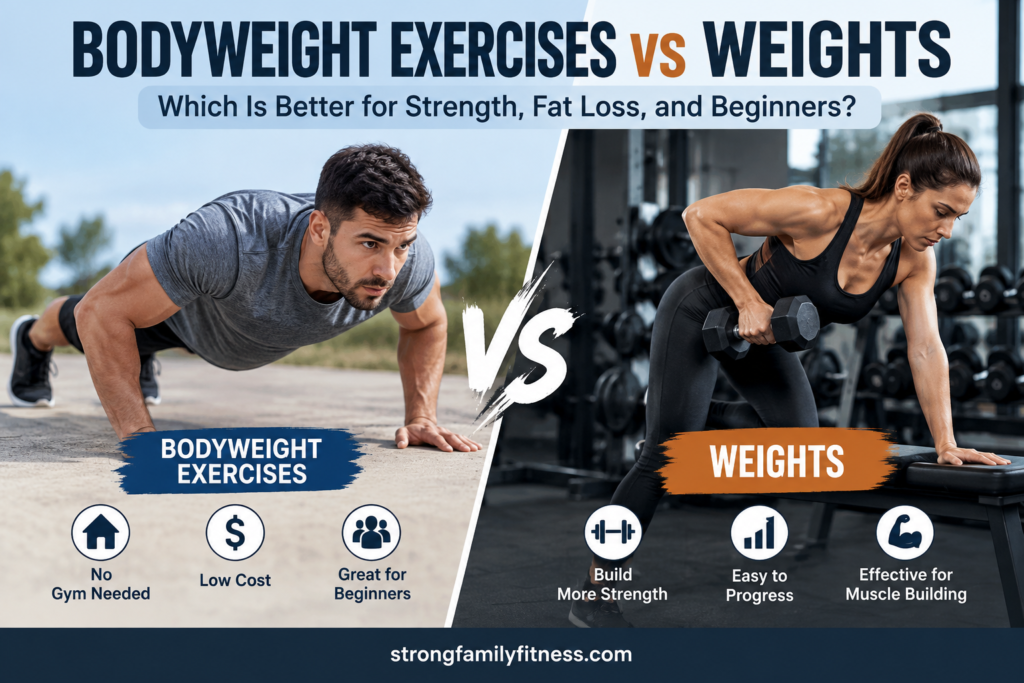
Introduction:
Strength training or bodyweight exercise: Is it really necessary to lift heavy weights to get stronger and lose weight? Do you ever stand in front of the rack of dumbbells and think about whether you are not doing enough good with push-ups and squats? You are not alone.
If you are tired of cutting calories and overdosing on cardio to lose fat and gain strength, then maybe it’s time to stop. Because even if your primary goal is weight loss, maybe there are easier ways to do this. How? By doing bodyweight exercises. Yes, it’s affordable, easier for beginners, and effective as well.
Bodyweight Exercises vs Weights: Which One Should You Choose?
Strength training builds resilience. If you are determined to get stronger, shed some fat, and get physically active, then weightlifting is arguably one of the best ways to go. But when it comes to bodyweight exercise vs weights, which one is better? Well, it’s not as simple to choose one over the other.
Both are forms of resistance training and can both improve strength and physical fitness with consistent use. The biggest difference is how easy it is to ramp up the challenge as your body adapts.
Bodyweight exercises can be a great way to learn basic movement patterns and establish a routine if you’re just starting. Weights are a simple way to increase resistance gradually and can be particularly helpful when strength and muscle-building goals become more advanced.
In this blog guide, we will discuss all about bodyweight exercises and weights. So, by the end of this guide, you will most likely be able to pick the right option for you.
Bodyweight Exercises vs Weights: What’s the Difference?
What Are Bodyweight Exercises?
Calisthenics means using your bodyweight as resistance for exercises. For bodyweight exercises, you don’t need complicated gym equipment and heavy weight lifting; you use your own body as resistance. The most common examples are squats, push-ups, lunges, glute bridges, pull-ups, step-ups, and planks.
What Is Weight Training?
Weight training means using external weights as resistance, for example, using dumbbells, barbells, and other resistance equipment.
Calisthenics vs Weight Training:
The basic difference between calisthenics and weight exercises is how you progress. In weight exercises, you can increase resistance by progressing through small, measurable increments. In bodyweight exercises, you progress by changing the exercise, progressing to more challenging exercises, or by increasing repetitions and sets.
So, basically, calisthenics vs weights don’t really mean easy vs hard. Both of them can be challenging; it is just how you create those challenges.
So, here’s what you can do:
Can’t access the gym?
Try squats, lunges, push-ups, pull-ups, and resistance band exercises.
Access to minimum exercise equipment?
Try dumbbell squats, overhead presses, and dumbbell rows
In short, you can gain maximum with minimum resources.
Bodyweight vs Weights for Strength: Which Builds More Strength?
It is not really a question of what’s better for strength; it may be better to put it like “what works better for you”. Both have equal benefits; it’s up to you to make a better choice based on your current fitness and the strength you are determined to achieve.
Resistance exercise results in the muscles adapting to the challenges applied to them. The most recent ACSM (American College of Sports Medicine) position statement released in 2026 analyzed 137 systematic reviews with more than 30,000 individuals participating and found that progressive resistance exercise enhances muscular strength, size, power, endurance, and function in healthy adults.
When Bodyweight Training Works Well for Strength
Bodyweight exercise works well for beginners, especially if you are new to resistance. If you find push-ups challenging, then you may start with wall or incline push-ups. As you gain strength, you can progress to floor push-ups and other variations of bodyweight exercises.
This same agenda goes for lower-body exercises like squats. This is one way of progressing bodyweight challenges:
Bodyweight squat → split squat → Bulgarian split squat → single-leg squat variation
When Weights Have an Advantage:
Well, it is easier to measure progression with weights. For example, if you start dumbbell squats with 20 pounds and get used to it, then you can increase the weight when you feel ready.
According to the ACSM review published in 2026, higher load training was especially efficient in increasing voluntary strength, whereas progressive resistance training had a positive effect on strength and muscle size.
So, if your main goal is building maximum strength, or continuing to make measurable progress as an experienced lifter, weights tend to be more flexible.
In short, bodyweight exercises can make beginners a lot stronger; however, weights are a very convenient way to keep increasing resistance as strength advances.
How to Build Muscle with Bodyweight Exercises?
Do you think you can build muscles with bodyweight exercises? Yes, you can. It is totally up to you how determined you are and willing to put effort to reach your goal. Your muscles respond to resistance. It doesn’t matter where the resistance comes from: bodyweight or external sources.
Bodyweight exercises can do a pretty good job of stimulating muscle growth for starters. However, if you haven’t done strength training before, then you need to be careful while gradually progressing to challenging exercises.
Body weight exercises can be made more challenging in the following ways:
- Increase number of repetitions/sets
- Decrease speed of movement
- Incorporate a larger range of motion
- Switch from two to one limb
- Select a harder variation
- Reduce assistance
- Progressive increase in training volume
A good example is that of a beginner who finds regular bodyweight squats sufficiently challenging. On the other hand, a regular exerciser will have to use harder variations.
Weights could seem more useful at times because it is easier to add measurable external weights instead of finding challenging bodyweight variations.
It means building muscle with bodyweight exercise is not about finding the magical exercise; it is about regular training, providing enough resistance, continuous progression, and allowing your body to recover and adapt.
Weights vs Bodyweight for Fat Loss: Which Burns More Fat?
Weight loss is quite a common factor most people are worried about. Are you wondering which burns more fat: weight or bodyweight? Let me tell you, neither of them works as a magic potion for fat loss. It requires determination, consistency, hard work, and patience, along with exercise.
Losing fat happens when your body is using more energy than you are consuming over time. Physical activity requires excessive use of energy, while nutrition is key in developing the energy gap or calorie deficit that helps you lose weight. According to the CDC, physical activity is a crucial component of weight loss and weight maintenance.
Does Bodyweight Training Burn Fat?
The short answer is “yes”. And the long answer is, well, it depends on several factors like body size, exercise intensity, workout time, and the fitness level you are currently at.
Bodyweight training also uses energy, which is how it helps with fat loss, but consistency is the key, along with other factors. Even for some people, bodyweight exercises combined with aerobic activity and resistance training work even better than relying on certain regular weight exercises.
Research also backs the fact that resistance training improves body composition in a holistic manner. A systematic review of healthy adults found that resistance training was associated with reductions in body-fat percentage, fat mass, and visceral fat compared with no-exercise controls.
So in the case of weights vs bodyweight for fat loss, the better option is usually whatever type of resistance training you can stick to consistently. Ideally, it shouldn’t be the only form of exercise you do.
Will Bodyweight Exercise Help Lose Belly Fat?
Bodyweight exercise is considered the better option for beginners who want to lose belly fat and are completely new to exercising. Another reason why it helps is that you don’t have to learn how to adjust weight machines or several other pieces of exercise equipment. You can start slow but steady. Start with something basic as lunges, hip bending, squatting, and pushing.
This doesn’t imply that beginners shouldn’t use weight equipment at all.
If combined with proper instruction and moderate loads, dumbbells and machines can be used as well.
It is not necessarily complex routines that constitute the best exercises for beginners’ strength training. Instead, a simple workout that engages the major muscle groups and teaches proper form can be a lot better place to start.
Comparison Table: Bodyweight Exercises vs Weights
Let’s take a quick look at different factors to compare for weights vs bodyweights exercise:
| Factor | Bodyweight Training | Weight Training |
|---|---|---|
| Equipment | Not really required | Dumbbells, barbells, machines, etc. |
| Expenditure | Affordable, mostly free | A gym membership or home gym equipment is required |
| Flexibility | Excellent for home workouts | More accessible with gym access |
| Beginner-friendly | Yes | Yes, by following a set of instructions |
| Strength gains | Effective | Highly effective |
| Muscle building | Effective, especially for new exercisers | Easier to progressively load |
| Increasing intensity | Possible through variations and volume | Measurable incremental loads make it easy |
| Fat loss | Supports overall activity and body composition | Supports resistance training and body composition |
| Exercise variety | Average to high | Quite high |
| Tracking progress | Can be hard sometimes | Easier most of the times |
| Advanced training | Can become technically challenging | Easier to add substantial resistance |
How Long Until You See Results?
Consistency is the key to gain your marked goal. Everyone’s body react differently to physical activity, and hence offer results in varying timelines. Few factors that also contribute in results can be:
- Current fitness level
- Nutrition
- Difficulty level of exercise
- Sleep schedule
- Age
- How consistent you are
- What is your goal
Some people may observe changes sooner that other, like better everyday movements and being able to use heavier weights. You may also see improvement in your coordination and balance. Other than that, achieving your final goal may take longer.
Can You Combine Bodyweight Exercises and Weights?
Absolutely; even for some people, the combination of bodyweight exercises and weights works better than anything else. While lifting weights helps you gain strength and build muscle, bodyweight exercise improves your coordination and balance, so it’s a win-win.
FAQs:
1. Is it possible to gain strength without weights?
Indeed, bodyweight exercise can play a significant role in gaining strength for beginners. However, it is important to be progressive. If the exercise starts feeling easier to you, then increase the difficult by trying different variations or adding volume.
2. Which is better: bodyweight exercise or weightlifting?
There is no win or lose when it comes to bodyweight exercise vs weights; both can work. Bodyweight training is flexible and more convenient for beginners because they can gradually progress from easy to hard, with no or minimum equipment required.
3. Does bodyweight exercise help lose belly fat?
Bodyweight exercise may help shed overall fat, but specifically targeting abdominal fat may not be that efficient. Our body determines where it stores and loses fat. Regular physical activity can contribute to reducing body fat and improving health, while resistance training can help support muscle during weight loss.
4. Can bodyweight exercises be as effective as lifting?
It can be a good way to build strength and muscle, especially with enough resistance in the exercise. Weights, however, make it easier to increase the external load progressively, and this can be useful for those trying to achieve more advanced goals of strength or hypertrophy.
5. What is best suitable for beginners?
Beginners should start with manageable exercises, gradually progressing to advance levels. U.S. guidelines recommend muscle-strengthening activities at least two days per week for adults, alongside regular aerobic activity. Beginners who are currently inactive may need to build toward these targets gradually.
Final words:
In the end, we conclude that there is no debate on which one among bodyweight exercises vs weight is better for you. If you are a beginner and you want to try out a variety of choices to gain strength, then you may start with basic bodyweight exercises. It is flexible, affordable, and more convenient for individuals who are currently inactive.
You can also start with using gym equipment to increase resistance, gain strength, and build muscle, while slowly progressing with measurable incremental overloads.
It doesn’t mean that you have to stay with one of them forever. You can gradually progress and pair both up for effective outcomes in terms of muscle-building and fat loss.
It doesn’t matter what looks more impressive; what matters most is the one you can perform patiently, progressively, and with consistency.
Stay strong, stay healthy; that’s how you make your way through life.
Reference links:
CDC — Adult Physical Activity Guidelines — Current U.S. recommendations for aerobic and muscle-strengthening activity.
American College of Sports Medicine — 2026 Resistance Training Position Stand — Major evidence review covering resistance-training effects on strength, hypertrophy, power, and physical function.
PubMed — Resistance Training and Fat Loss Meta-Analysis — Systematic review examining resistance training and body-fat outcomes.
PubMed — Resistance Exercise During Dietary Weight Loss — Recent systematic review examining fat-free mass, fat loss, and strength during weight loss.
PubMed — Resistance Training With Different Loads — Systematic review and meta-analysis examining muscle growth and strength across different resistance loads.
Consider your individual circumstances and consult an appropriate qualified healthcare professional when needed.