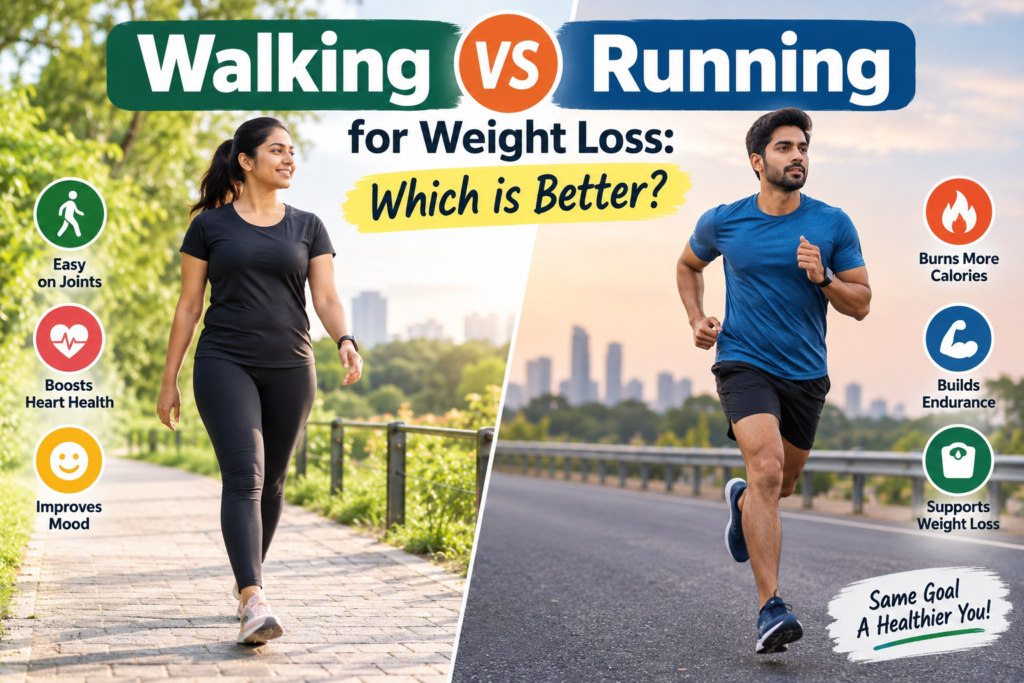
Walking or running for weight loss have a number of health benefits. Your mobility, personal preferences, and health goals will determine the best option for you. Walking and running are both excellent methods of heart strengthening. There isn’t a perfect “better” choice. Your exercise and health goals will determine the best choice for you.
Running is not always the better choice, even though it frequently burns more calories per minute than walking. The ideal option is one that is enough suitable with your preferences, way of life, and degree of fitness to be maintained over time.
Walking vs. Running for Weight Loss: What’s the Difference?
Walking for Weight Loss

Benefits of Walking
If you are new to regular exercise, walking is a fantastic choice. Build up to longer, more strenuous travels by starting with shorter ones. There are some amazing benefits of walking to lose weight
- Maintaining lean muscular mass: It’s either use it or lose it. Walking aids in maintaining and strengthening muscular mass while losing weight. As you age and naturally lose muscle, this is very crucial.
- Boosting your metabolism: Over time, a higher metabolism can help you lose weight by increasing the quantity of calories your body burns both during activities and during rest.
- Improving mood and reducing stress: Walking can support mental well-being and may help reduce stress. Walking causes the release of endorphins, or happiness hormones. In addition, being surrounded by nature can have a soothing effect on the nervous system, alleviating the negative effects of sensory overload, exhaustion and overstimulation.
How Many Calories Does Walking Burn?
Length, walking speed, and body weight are the key determinants of how many calories burned walking. A person with a larger body weight will usually burn more calories during the same activity, and walking at a quicker rate usually consumes more energy than walking at a slower pace.
For example, calorie estimates for walking at different speeds can range from approximately 2.9 to 7.2 calories per minute, depending on body weight and walking pace. These figures are estimates, so actual calorie expenditure can vary from person to person.
You will burn more calories if you weigh more since moving more mass requires more energy. Similarly, losing weight will result in lower calorie expenditure.
Running for Weight Loss

Benefits of Running
Running is a great cardiovascular workout that burns a lot of calories, making it a great way to lose weight. Running can help you lose those extra pounds in the following ways:
- Calorie-burning power: Running is a high-intensity workout that targets multiple muscle groups. Running uses a lot of energy, so you can burn more calories in less time. The more calories you burn, the more likely you are to lose weight.
- Lower abdominal fat: Visceral fat, which builds up around your abdominal organs, can be effectively reduced by running.
- Improve mental health: The body feels more at ease when it runs for thirty minutes every day because it releases a lot of endorphins, which encourage “euphoria” both during and after the run. Frequent running has numerous positive effects on mental health, such as lowering stress and anxiety and boosting vitality.
Although there isn’t a “one-size-fits-all” exercise regimen that works for everyone, running is an excellent method for weight loss. Your current fitness level, body composition, overall health, and personal preferences all influence how successful weight loss training is. Certain workouts have special advantages and might be better for some people than others.
How Many Calories Does Running Burn?
Running is a demanding sport that can take a lot of energy in a short period of time. A 154-pound person running/jogging at 5 mph, for example, may burn around 295 calories in 30 minutes, according to CDC figures. Your real calorie expenditure may vary depending on your body weight, running distance, terrain, and pace. Because running requires more energy, it can be a good option for people who like higher-intensity training.
Calorie Comparison
Calorie expenditure varies from person to person, but walking and running generally require different amounts of energy depending on intensity, speed, body weight, and duration. The CDC provides the following estimates for a 154-pound person:
| Activity | Approx. calories / 30 min | Approx. calories / hour |
| Walking 3.5 mph | 140 | 280 |
| Running/jogging 5 mph | 295 | 590 |
| Walking 4.5 mph | 230 | 460 |
These are estimates, not promises. The CDC specifically notes that calorie expenditure is higher for people who weigh more than 154 lb and lower for people who weigh less.
What Role Does Exercise Have In Losing Weight?
Physical activity plays an important role in weight management because it increases the number of calories your body uses for energy. A calorie deficit, which can result in weight loss, is created when you combine regular exercise with a diet that offers fewer calories than your body consumes.
Walking and running might also help with this process. Running frequently consumes more calories per minute owing to its higher intensity, but walking can still increase calorie expenditure and may be easier to maintain on a regular basis. The quantity of exercise needed to lose weight varies from person to person, so there is no one amount of walking or jogging that guarantees a particular result.
The CDC advises individuals to engage in muscle-strengthening activities at least twice a week in addition to 150 minutes of moderate-intensity aerobic activity or 75 minutes of vigorous-intensity activity per week for overall health.
How Much Exercise Is Necessary To Lose Weight?
The current CDC guidance recommends that adults get:
- 150 minutes of moderate-intensity aerobic activity per week
- 75 minutes of vigorous-intensity activity per week
- An equivalent combination of the two
According to the CDC, Adults should also perform muscle-strengthening activities on at least 2 days per week.
According to the HHS Physical Activity Guidelines, one minute of intense activity is about equal to two minutes of moderate activity in order to achieve the aerobic activity guidelines.
Which one to choose
Your level of fitness and overall health will determine whether walking or running is better for you. Your own objectives and the amount of time you have available for exercise may also play a role. There are genuine advantages to both running and walking. Selecting what suits your physique and way of life is crucial.
Walking might be a better option if you:
- Are new to exercise
- Have arthritis, joint discomfort, or other long-term medical issues
- Carry excess weight
- Prefer less strenuous exercises
- Want a lower risk of injury
Running might be a better option if you:
- Desire more bone-strengthening advantages
- Enjoy higher-intensity workouts
- Have no significant joint or health restrictions
- Have little time to work out
- Want a higher intensity workout
Conclusion
Walking or running for weight loss both are good in their own ways. Walking can still be a useful physical exercise for managing weight, even though running often burns more calories per minute. In general, neither is superior. The optimal option is determined by your degree of fitness, your tastes, the time you have available, and what you can accomplish on a regular basis.
FAQ
Can walking every day help you lose weight?
Walking can contribute to weight loss by increasing energy expenditure, particularly when combined with an appropriate eating pattern. However, the amount of weight someone loses varies substantially between individuals.
How long should I run or walk in order to lose weight?
Don’t offer a time frame that guarantees a certain quantity of weight loss. Instead, describe how adults should gradually raise their level of activity based on their circumstances and level of fitness while working toward the federal weekly activity recommendations.
Can walking help me start running?
Indeed. For some beginners, it may make sense to start with walking and progressively add jogging intervals. MedlinePlus advises those who were previously inactive to start out cautiously and gradually increase their level of activity.
Consider your individual circumstances and consult an appropriate qualified healthcare professional when needed.